In this article, we will try to create a trading strategy that is objective and unambiguous. Everyone should arrive at the same interpretation of the rules, regardless of their personal opinions.
Let’s revisit the key requirements of an objective trading strategy:
- Clear rules
- Clearly defined entry conditions and entry points
- Clearly defined exit conditions and exit points
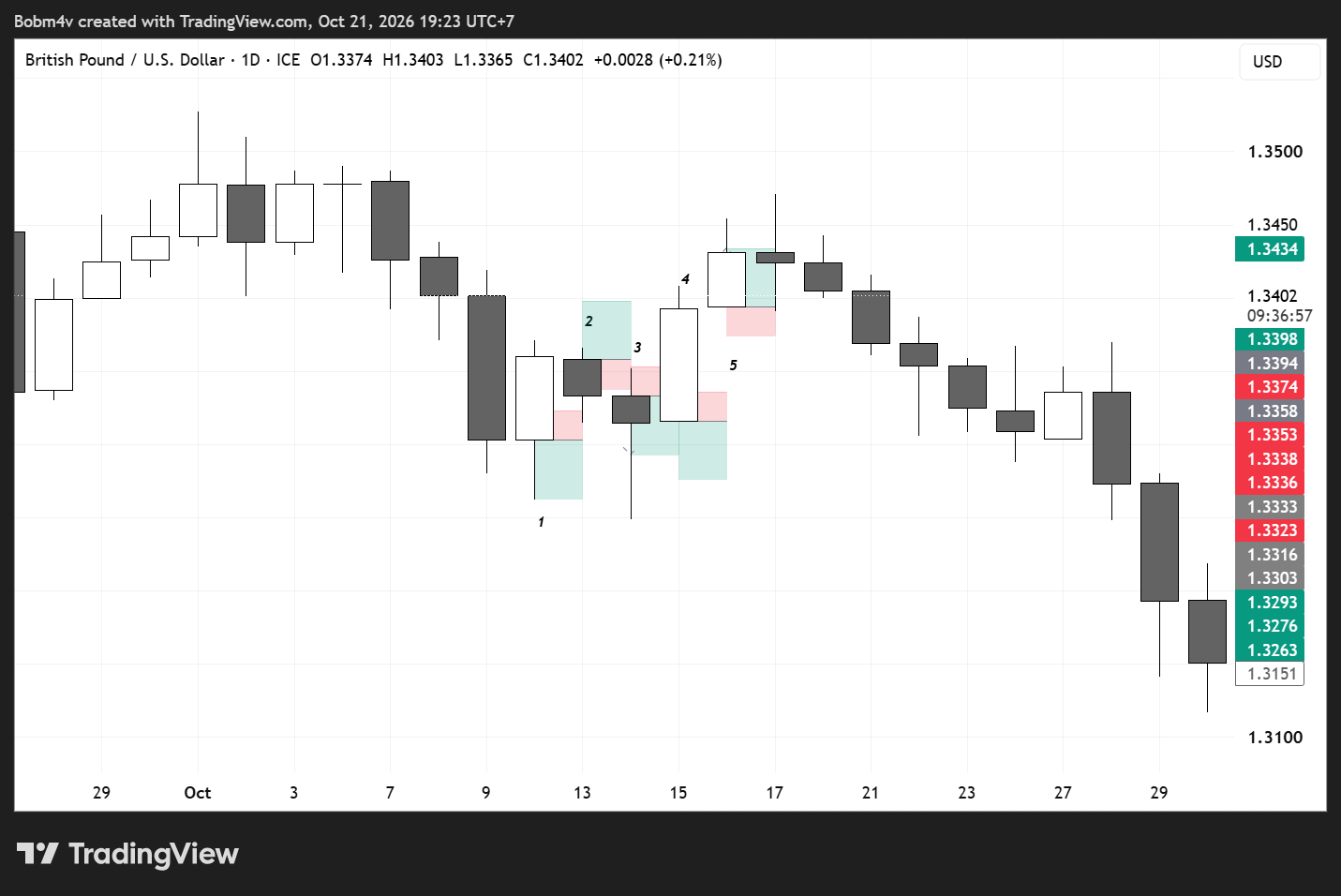
Now, take a look at the chart below.
Defining the Trading Rules
The chart above shows GBP/USD on the D1 timeframe, which means each candle represents one day. I’m sure you already know that, right?
Let’s define the rules of this strategy.
1. Trading Rules
We will only use the D1 timeframe and the GBP/USD pair with a specific broker that we have selected. This is important because candle formations can sometimes differ between brokers.
2. When and Where to Enter
I will enter a sell position at the market open today if yesterday’s candle closed bearish. I will enter a buy position at the market open today if yesterday’s candle closed bullish.
Even if a candle is only slightly bullish or bearish, as long as it can be identified as bullish or bearish, we will use that signal.
3. When and Where to Exit
I will only exit a buy or sell position when either the Take Profit (TP) or Stop Loss (SL) is hit.
Never change this rule during the test, because doing so could affect the backtesting results. In this example, the SL is 20 pips and the TP is 40 pips. These values can be adjusted when testing different variations of the strategy.
Let’s Review the Results
Now, let’s discuss the results based on the numbered candles in the image.
- Candle 1: In my view, the TP was hit first before the price moved up, giving us +40 pips.
- Candle 2: The SL was hit, resulting in -20 pips.
- Candle 3: The TP was hit, resulting in +40 pips.
- Candle 4: The SL was hit, resulting in -20 pips.
- Candle 5: The TP was hit, resulting in +40 pips.
So far, we have hit TP three times and SL twice.
The total result is:
- Total profit: 3 × 40 pips = 120 pips
- Total loss: 2 × 20 pips = 40 pips
- Net result: +80 pips, before transaction costs.
Do you understand how this strategy works, everyone?
One Important Thing to Consider
There is one important detail we need to consider when evaluating a strategy using the D1 timeframe.
Each daily candle shows the opening, highest, lowest, and closing prices for that day. However, it does not show the exact sequence in which prices moved between those points.
What if the price hits both the TP and SL levels within the same daily candle?
Using D1 data alone, we may not be able to determine which level was reached first. If we simply assume that the TP was hit first, we could overestimate the strategy’s performance. The opposite assumption could underestimate it.
To handle this situation more reliably, we can use lower-timeframe data to investigate the price movement in greater detail. Alternatively, we can establish a consistent testing assumption for every ambiguous trade and clearly document that assumption.
The important thing is to apply the same method throughout the backtest. We should not choose whichever outcome produces the most favorable result.
Your Turn to Try It
Creating an objective trading strategy can be this simple.
Your task now is to try it yourself using any currency pair you like. Keep the rules consistent and record the results.
Is this strategy profitable?
To find out, we need to conduct a backtest.
What is backtesting, and how do we do it? We’ll continue in the next article!
If you have any questions or comments, feel free to share them. I’m happy to discuss them with you.
Risk Disclaimer: This article is intended for educational purposes only. Forex trading involves the risk of financial loss, and historical testing results do not guarantee future performance.
A prime example of this objective structure in live markets is documented in our Train Station Guide to Round Numbers and the mechanical execution rules in The XAU/USD Round Number Strategy (M15).
Official Automated Expert Advisor • 100% Free
Automate This Strategy with the Round Number Gold EA
Why calculate Round Number levels and manage pending orders manually? Download the official MT4 Expert Advisor with embedded 1:3 RR math, automatic pending order purge, and the exact backtested preset (+339% gain on Exness-Real33).
Leave a Reply