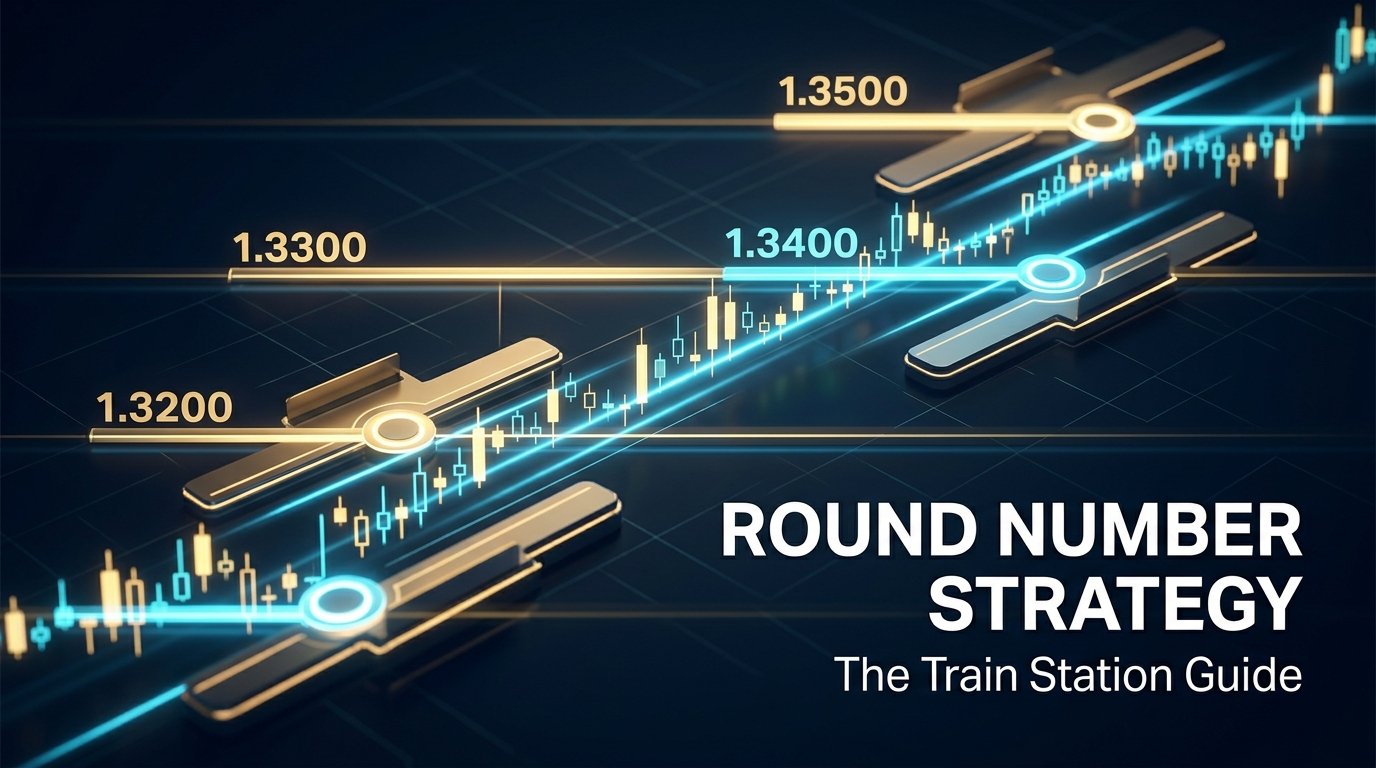
At its core, the Forex Round Number Strategy is a grounded variation of support and resistance. Traders who practice this approach believe that across currency pairs, specific round numbers act as psychological barriers where price tends to hesitate, stall, or reverse. That is the baseline premise of round numbers.
Every trader has their preferred numbers depending on the pair. On GBP/USD, for instance, key psychological levels often sit at 1.3200, 1.3300, 1.3400, and 1.3500. When price approaches these milestones, market participants take notice, orders cluster, and you frequently see visible price reactions.
Take a look at the daily chart below to see these psychological boundaries in action:
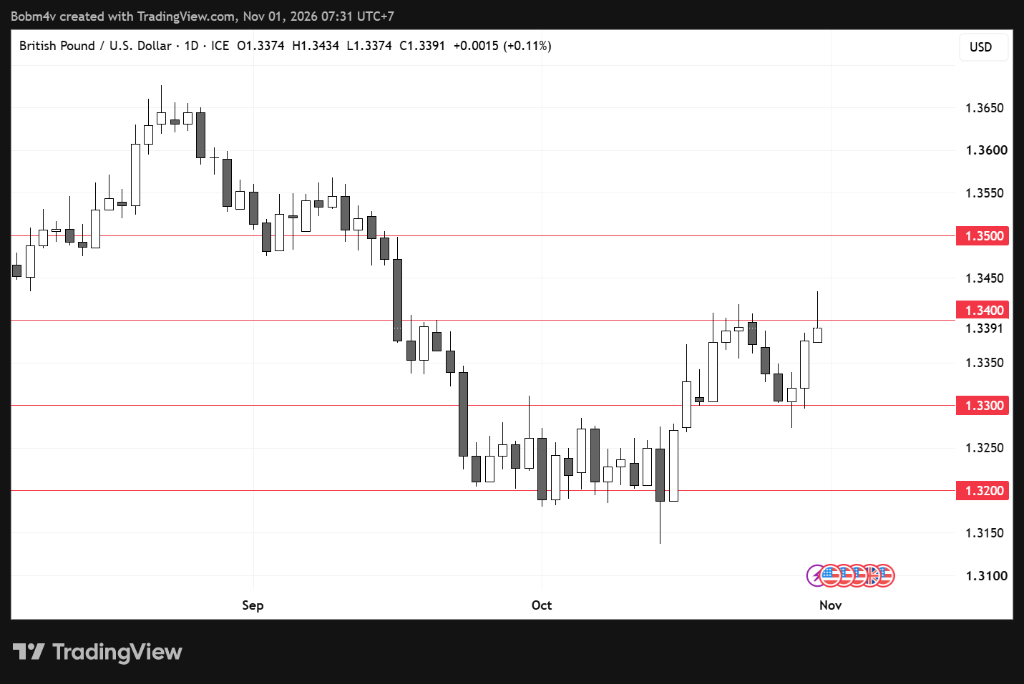
You can clearly see how price respects these horizontal marks. That is the foundational concept of round numbers: identifying round figures that serve as natural psychological pivot points.
From Counter-Trend Reversals to Trend Following
While many traders use these levels looking for quick counter-trend reversals, the strategy can be developed in multiple directions. If you want to build a trading model that can be rigorously backtested, the first rule is simple: remove personal subjectivity.
I personally prefer using round numbers for trend following rather than fighting the market momentum. When a genuine trend unfolds, conventional support and resistance zones tend to break, and price pushes in the direction of the underlying momentum until it reaches exhaustion.
The Train Analogy: Finding Fixed Stations
Most trend-following traders rely on pullbacks, waiting for a “discount zone” before joining the trend. A common analogy compares a strong trend to a speeding train: jumping onto a train while it rushes at full speed is dangerous, so you wait for it to slow down at the next station.
The real issue arises when defining that station. During backtesting, traders often mark stations subjectively, picking arbitrary swing highs, swing lows, Fibonacci ratios, or order blocks. In live conditions, hindsight disappears, and two traders will mark two completely different stations on the exact same chart.
With a round number strategy, we strip away that guesswork. Round numbers serve as pre-planned train stations where we anticipate price interaction. Regardless of how wild or messy the candlesticks look, the station coordinates are permanent. 1.3300 is 1.3300 yesterday, today, and tomorrow.
Look back at the GBP/USD chart between September and October. Observe how cleanly price transitioned from 1.3500 down to 1.3200. Instead of second-guessing where to enter, a systematic trader can position predefined pending orders directly around these psychological checkpoints.
What Comes Next
This article serves as the opening chapter in our exploration of round numbers. In upcoming posts, we will dive deeper into order execution mechanics, filtering false breakouts, and developing rule-based algorithms to automate this framework.
What are your thoughts on trading round psychological levels? Do you prefer counter-trend bounces or trend continuation? Drop your thoughts or feedback in the comments section below, and let’s discuss.
For the complete institutional implementation of this train station concept on Gold with precise 50-point grids and hard stop losses, refer to our comprehensive guide: The XAU/USD Round Number Strategy (M15).
Official Automated Expert Advisor • 100% Free
Automate This Strategy with the Round Number Gold EA
Why calculate Round Number levels and manage pending orders manually? Download the official MT4 Expert Advisor with embedded 1:3 RR math, automatic pending order purge, and the exact backtested preset (+339% gain on Exness-Real33).
Leave a Reply