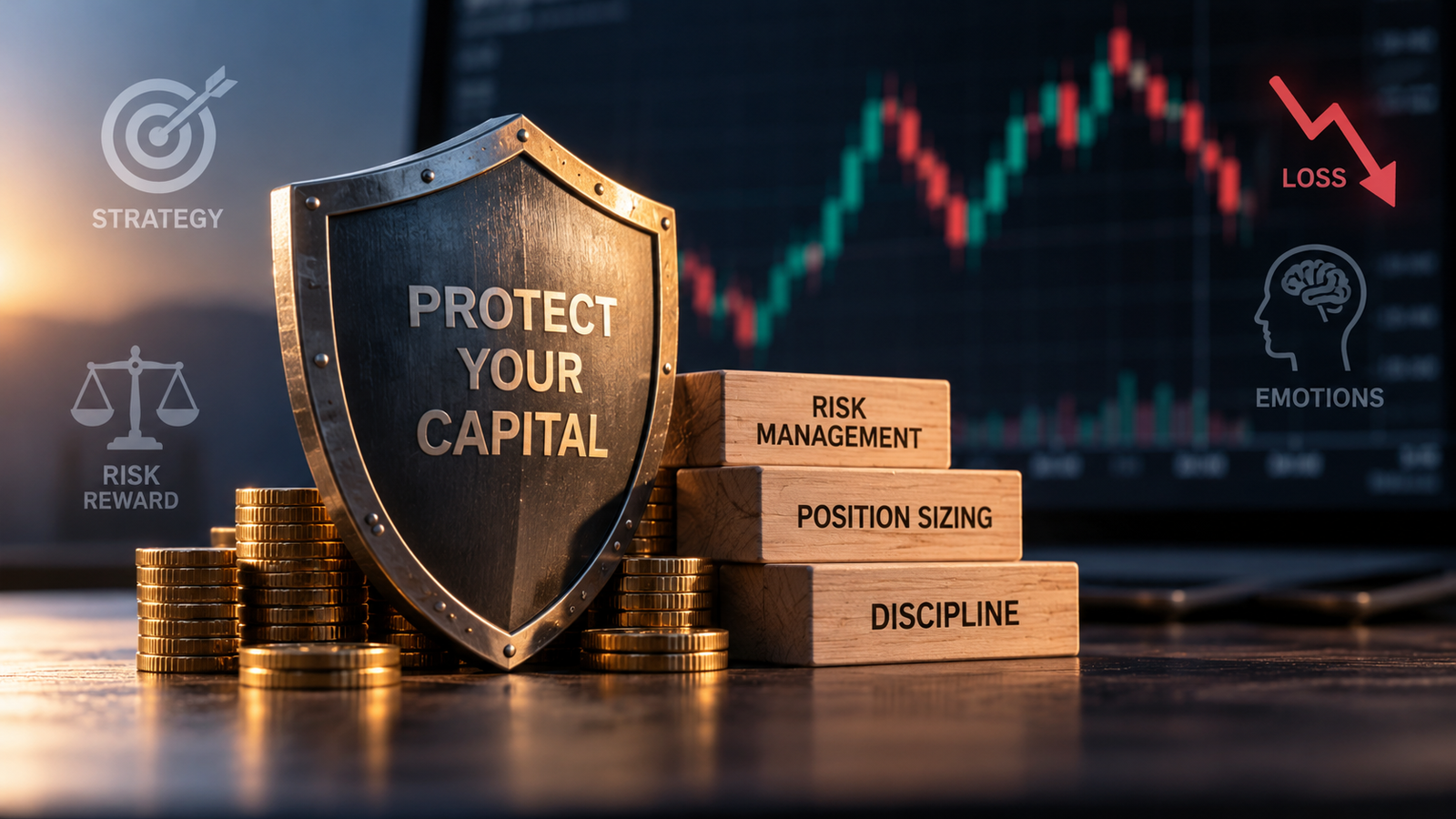
“If you cannot make money, it is better than losing money.” These are the words of a professional trader that have always stayed with me.
For me, this is the fundamental principle of money management. No matter how good your trading strategy is, it will be of little use if you do not apply proper money management.
I will try to write about money management from my own perspective and based on what I have learned. Most of what I share comes from my personal experience throughout my journey in trading.
Understanding the Concept of Money Management
In general, money management is a branch of financial management that deals with the planning, organization, allocation, monitoring, and control of financial resources in a systematic way to achieve financial goals while minimizing the risk of loss.
In the world of trading, money management becomes one of the most critical pillars that can determine whether a trading account survives or fails. In general financial management, the focus may be on long-term financial allocation. In trading, however, money management focuses on how we manage our capital in each position to survive and pursue consistent profitability.
Without proper money management, even a trading strategy with a 90% win rate could lead to significant losses if one or two large losses occur.
I have also come across many articles on the internet claiming that 90% of trading success depends on money management rather than the strategy itself.
So, why is money management so important, and why is it often considered one of the keys to success in trading? Keep reading to explore this topic further.
Money Management and Trading Risk: Risk vs. Capital
In trading, especially Forex, there is a concept known as risk per trade. According to many traders who have managed to survive in the Forex market for a long time, risk per trade is one of the most important elements of money management.
Imagine that you have $1,000 in trading capital and risk 10% of your capital on each trade. If you suffer ten consecutive losses, your capital will be severely depleted. This illustrates why risking too much on each trade can be dangerous.
Many experienced traders choose to risk only 1–2% of their capital per trade. They understand that not every battle can be won. When they lose, they still have capital left to recover and continue trading.
For example, if you risk 1% of your remaining capital per trade, ten consecutive losses would leave you with approximately 90% of your original capital. You would still have most of your capital available.
Using a smaller risk per trade can also help reduce emotional pressure and the temptation to recover losses immediately. This desire for revenge trading is often one of the behaviors that can cause traders to make even worse decisions.
The Relationship Between Risk-Reward Ratio and Money Management
By definition, the Risk-Reward Ratio (RR) measures the relationship between the potential loss (risk) and the potential profit (reward) associated with a trading decision.
Earlier, I discussed risk per trade. Another important concept is the risk-reward ratio, which is closely related to the trading strategy we use.
For example, if we know that a strategy has a 50% win rate, using a 1:1 risk-reward ratio would produce a break-even result before transaction costs, assuming the planned risk and reward are achieved consistently.
In reality, however, the result would be negative after accounting for trading costs such as spreads and commissions.
Therefore, if a strategy has a 50% win rate and uses a 1:1.5 risk-reward ratio, it would have a positive expected result before transaction costs, assuming the strategy consistently achieves those figures.
But does a 50% win rate always require a 1:1.5 risk-reward ratio to be profitable? We explore this question further when evaluating historical data.
Other Important Concepts in Money Management
You may have heard of several other key concepts, such as losing streaks, drawdown, and backtesting. To explore these topics in depth, read our detailed guides on Mastering Backtest Metrics and Connecting the Dots of Backtesting.
Final Thoughts
Ultimately, we all need to understand that trading is not just about having a good strategy. Money management is also a fundamental part of building a sustainable trading approach.
A strategy may look promising, but without proper risk management, it can still expose us to substantial losses.
That is all I would like to share about money management for now. If you have any thoughts or questions to discuss, feel free to leave a comment.
See you in the next article!
For an empirical mathematical deep dive into surviving statistical losing streaks, read our breakdown of The 1% Rule During Losing Streaks and see how strict risk limits govern our Gold M15 Framework.
Official Automated Expert Advisor • 100% Free
Automate This Strategy with the Round Number Gold EA
Why calculate Round Number levels and manage pending orders manually? Download the official MT4 Expert Advisor with embedded 1:3 RR math, automatic pending order purge, and the exact backtested preset (+339% gain on Exness-Real33).