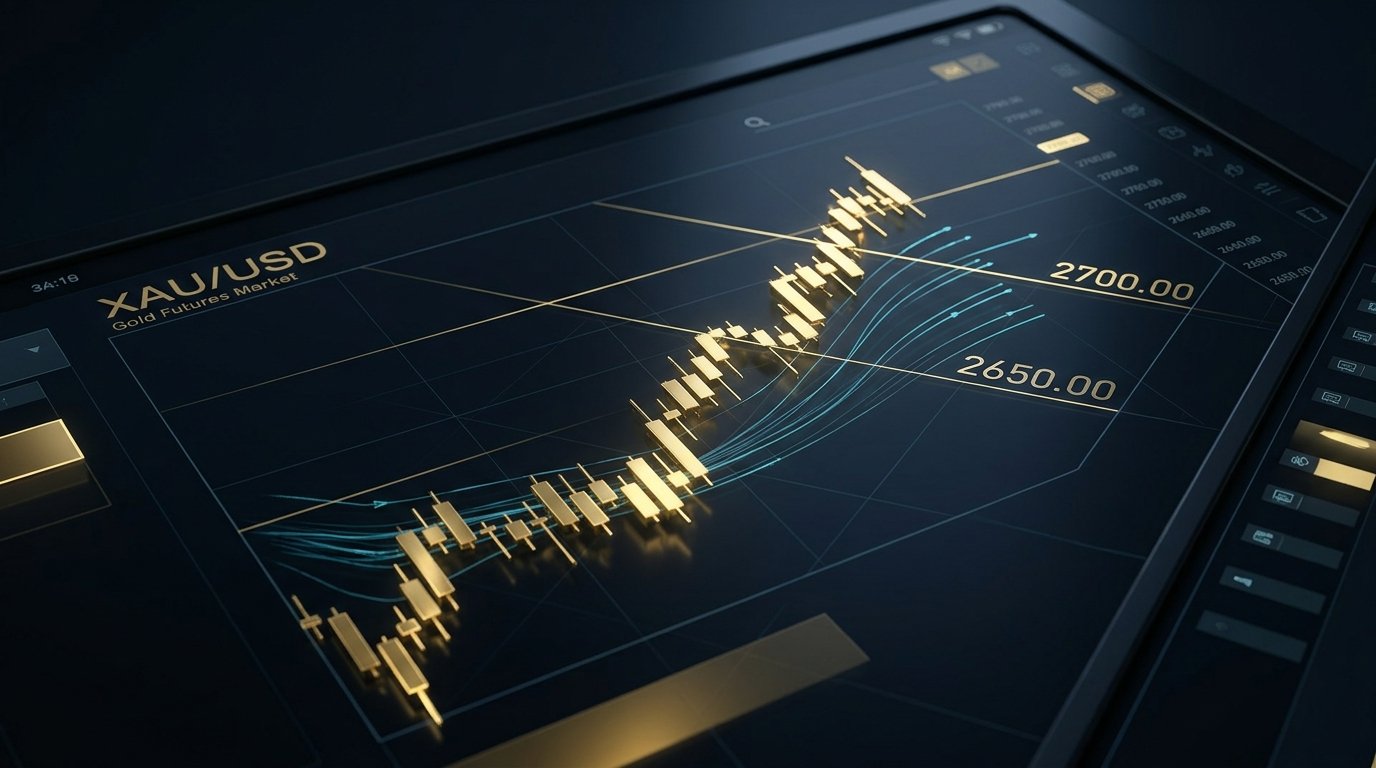
Over the years of studying financial price action, I have come back to one simple truth: a sound trading strategy does not need to be complicated. Yet, why do so many traders struggle to produce consistent outcomes from straightforward ideas?
The breakdown almost always stems from two real-world hurdles: the physical limitations of human execution speed, and the mental inconsistency between how a system is backtested versus how it is executed live.
Exhaustion from dealing with these exact friction points is what originally led me to automate my manual Round Number system into a MetaTrader 4 Expert Advisor. In this article, I want to openly document the mechanics behind that automation, the structural behavior of Gold that powers it, and why strict statistical consistency between backtesting and live trading is the only thing that protects your edge.
1. The Speed Bottleneck: When Human Fingers Lag Behind Market Velocity
Most traders assume automation exists purely to eliminate fear and greed. While emotional detachment is a welcome benefit, the primary reason I automated this system was sheer execution speed.
In highly volatile markets like Gold (XAU/USD), price action unfolds in seconds. When price begins coiling near a major psychological round number, the liquidity vacuum breaks violently. Momentum does not wait for you.
Executing manually in fast markets is full of friction. You have to monitor the chart, calculate distance, type the entry price, calculate your stop loss, and click send. Very often, before your fingers finish typing the order ticket, Gold has already exploded 30 to 50 points past your planned entry.
You are left with two bad choices: miss the trade entirely, or chase a runaway price and ruin your risk-to-reward ratio. Automation removes that latency entirely. An automated script evaluates price thresholds and dispatches pending orders in milliseconds, right when the structural setup forms.
2. Why I Tailored This System Strictly for Gold (XAU/USD)
From day one, I never attempted to build a generic robot that claims to trade every currency pair. In my experience, jack-of-all-trades algorithms usually fail because every financial asset possesses a distinct structural DNA.
I locked this system exclusively to Gold on the 15-Minute (M15) timeframe for two specific reasons:
- Raw Velocity: Traditional foreign exchange pairs like EUR/USD or AUD/USD tend to oscillate in tighter ranges and frequently mean-revert around round numbers, creating false breakouts. Gold behaves differently. Its institutional volume produces sudden, directional momentum runs.
- Prolonged Trend Extensions: When Gold convincingly clears a key round number station (such as 2,650.00 or 2,700.00), it rarely stops immediately. The resulting order flow often drives an aggressive trend of 500 to 1,500 points (50 to 150 pips). That directional runway is what gives the strategy a healthy reward-to-risk ratio.
Does this mean the Round Number concept cannot work on other pairs? Absolutely not. Round numbers reflect human psychology, which is universal. However, if you wish to apply this framework to currencies like GBP/USD or equity indices, you must conduct your own research to discover a setup that fits that asset’s unique timeframe, point spacing, and daily volatility range.
3. The Three Mechanical Pillars Inside the Architecture
I am not a professional software engineer. I built this architecture from my manual trading journal, translating my exact rules into MQL4 code with the assistance of artificial intelligence (ChatGPT). The mechanics rest on three straightforward pillars:
A. Automated Round Number Station Mapping
Rather than manually drawing horizontal lines on the chart, the algorithm constantly calculates the nearest round number levels based on fixed point increments (such as every 100 or 500 points on Gold). The system remains idle until price enters a predefined proximity threshold around these stations.
B. Dual Pending Order Traps (Bracket)
When price consolidates near a station, the system does not attempt to predict whether the market will break upward or downward. Instead, it places a dual bracket of pending stop orders:
- A Buy Stop positioned slightly above the round number level to catch upward expansion.
- A Sell Stop positioned slightly below the round number level to catch downward expansion.
C. The OCO (One-Cancels-the-Other) Safety Mechanism
This is the most critical safeguard in fast markets. If price triggers one side of the bracket (for example, triggering the Buy Stop), the system instantly deletes the opposing Sell Stop order from the broker server. This guarantees that your account never gets caught in an unplanned dual hedge if the market experiences a brief retracement.
4. The Anti-Greed Law: No Martingale, Pure Binary Outcomes
Online forums are full of free robots that display smooth equity curves that appear invincible. When you look under the hood, almost all of them rely on martingale: doubling lot sizes on losing positions without a stop loss. That is not trading; that is a ticking financial bomb.
In this architecture, I strictly banned martingale, and I enforce one ironclad rule: every trade outcome is strictly binary. It either hits Stop Loss, or it hits Take Profit.
Over years of observation, I also discovered something that surprises many traders: trailing stops and moving stop losses to break-even often ruin the edge.
Gold is notorious for shallow retests. After breaking a round number, price frequently pulls back slightly to test the breakout level before surging into its main trend. If you use a trailing stop or aggressively move your stop loss to break-even, you will routinely get ejected right before the big move unfolds.
Once an order triggers, your risk is defined from the very first second. Give the trade room to breathe. Allow mathematical probability to play out completely without interference. You accept a controlled loss if it hits Stop Loss, or you collect the full reward if it reaches Take Profit.
5. The Critical Trap: Disparity Between Backtest Hours and Live Trading
This is the single most common reason why mechanical systems fail in retail hands:
If you backtest a strategy over a 24-hour cycle, you must run it live over that exact 24-hour cycle. If you backtest only during London and New York sessions, then run it live strictly during London and New York. Never change the operational window midway through.
Here is what happens in practice: a trader tests an algorithm across a full 24-hour dataset and confirms healthy net profitability. But when they launch it on a live account, they begin second-guessing the system during slower sessions.
For example, during the Tokyo (Asian) session, Gold price action may chop around, causing two or three small consecutive stop-outs. Feeling anxious, the trader manually shuts down the robot to avoid further losses. What they fail to realize is that in the backtest data, those quiet sessions occasionally produce clean trend breakouts that offset the chop.
By manually overriding the operating hours out of fear, you destroy the statistical integrity of the entire strategy. An algorithm is an impartial tool; the final result depends entirely on whether your execution environment matches your testing environment.
Final Reflections
Sharing this architecture is my way of openly documenting past research. Having stepped away from active trading in 2025, I hold no financial stake in the market, I run no managed accounts, and I sell no software.
Sustainable trading has never been about finding a magic system with a 100% win rate. It is about understanding the mechanical edge of your market, respecting the speed of price action, defining fixed risk on every entry, and allowing probability to do its work.
What is your perspective on binary trade outcomes? Do you find yourself tempted to move your stop loss to break-even too early, or do you have the patience to let trades play out to their original targets? Share your experiences and thoughts in the comments below.
Leave a Reply